library(tidyverse)library(gt)miege_models =read_csv2(";;;;Editorial Model;Flow Model;Written information modelIn the form of:;*cultural commodities* work reproduced in formats conferring a private good character; alternatively, rights of access allowing use of the work;*continuous flow* accompanied by audience loyalty;*information products* bought on a regular basisMain function:;publisher/producer;programmer;editor-in-chiefSector characterised by:;many small or medium-sized companies clustered around oligopolistic firms;quasi-industrial organisation and emphasis on purchase of rights;industrially organized creation and manufactureCreative personnel:;remunerated via copyright payments. Existence of incubators (= reservoirs of talent);generally on salary. Also contract and freelance;generally on salary. Also freelanceDistribution and revenue base:;direct sale to consumer, revenues in proportion to audience size;indirect via license fee/subscription tariff and/or advertising;mixed systems (sales to consumers and advertising receiptsMarket characteristics:;segmented mass market;mass market (generally undifferentiated but tending toward segmentation);mass market segmented or undifferentiated (e.g., newspapers enjoy geographical monopoly")cultural_industry_functions =read_csv2("Function;Creation;The creation of texts.Commodification;The conversion of texts into cultural products that can be disseminated on an industrial scale.Dissemination;The extraction of revenue from cultural products through consumers.")streaming_services_in_norway =read_csv2("Function;Publishing Industry;Music Industry;Movie IndustryCreation;Writers, Cappelen Damm;Artists;Production companies, NetflixCommodification;Cappelen Damm;Labels;Distributors, NetflixDissemination;Storytel;Spotify;Netflix")
Why study the (Norwegian) film industry?
Everybody needs cultural expression that they can relate to. Everybody needs to hear stories that relate to the places they relate to, people they relate to, struggles they relate to and joys they relate to. Often we can relate strongly to stories told by people in very different parts of the world; sometimes we need stories told by people closer to us.
Film, television, and computer industries in small countries and among small language groups have always relied on some form of government support in order to exist. However, to have any role in the public sphere, films not only have to exist. They must be seen and discussed.
According to Jostein Gripsrud (2000), cultural expressions are an intrinsic part of the public sphere and therefore an essential part of democracy. They imbue us with an understanding of ourselves, they introduce emotion into the public sphere, and they can directly influence public debate and policy, for better or worse.
This view of cultural expression, as something intrinsically more, and more valuable, than simply the industries in which it is generated is found at policy level not only in Norway, but also throughout the EU. The cultural industries are for this reason often administered and funded by ministries of culture, rather than ministries of industry.
This is nowhere more apparent than in the film, television, and computer games industries – the most “industrial” of the cultural industries due to their high production costs and reliance on large audiences to remain economically viable. These qualities also tend to make them the most global of the cultural industries, as only global audiences are big enough to support the most expensive productions.
A Norwegian film industry that serves the Norwegian public sphere well needs to be sufficiently popular while also telling stories that are in some measure different from those from Hollywood. It must also make room for stories that are original, marginal, or otherwise push at the boundaries of the public sphere.
In the last few decades the Norwegian film industry has made incredible progress in almost every measurable category. It is more economically robust than ever before, it tells stories that are more popular with home audiences than ever before, it tells stories that receive better critical acclaim than ever before, and it is more diverse than ever before.
Still, the concomitant rise of global platforms in home markets raises questions about how and whether these stories can reach audiences. To research the strategies local film distributors pursue therefore examines not only the viability of the industry, but also the impacts the Norwegian film industry has (or doesn’t have) on the public sphere.
In his book The Cultural Industries, David Hesmondhalgh (2019) traces the cultural industries approach to Horkheimer and Adorno’s polemic “The Culture Industry” ([1947] 1991) and to the more measured response to this work by Bernard Miège and other French sociologists in the 1970s and 1980s (Hesmondhalgh 2019, 29).
Miège rejects Horkheimer and Adorno’s use of the singular culture industry, arguing that multiple cultural industries remain heterogeneous. He does, however, embrace their concept of the cultural commodity (1989, 10–11).
(…) the crucial point is that the emergence of the cultural commodity in the field of production and consumption, which certain writers have described as the “commoditization of culture”, is due to the rapid development of reproducible products for private purchase (1989, 21)
In Horkheimer and Adorno’s view, the cultural commodity loses its cultural value and becomes just another product to be bought and sold according to capitalist logics. However, cultural products are not commodities in a strictly economic sense, where a commodity is a product generic to the point of cost being the only distinguishing factor, and Miège addresses the paradox of the cultural commodity’s needing to be both completely unique and an endlessly reproducible industrial product.
“The imprint of the artist must remain visible to the user: the product, even if it is reproduced in thousands of copies, must retain the traces of the work of the artist who conceived it.” (1989, 26)
To Hesmondhalgh, the cultural industries must be understood as “fundamentally ambivalent”. They are both a part of the “extreme inequalities and injustices (…) apparent in contemporary capitalist societies” [-Hesmondhalgh (2019) p. 10) and “[o]ften (not just occasionally) they tend to orientate their audiences towards ways of thinking that do not coincide with the interest of capitalists” (2019, 8).
Hesmondhalgh and Miège place cultural industries studies within a political economy tradition. In her book How Hollywood Works, Janet Wasko (2003) refers to Vincent Mosco (1996) for a definition of political economy that, she writes, considers how “societies are organized to produce what is necessary to survive, and how order is maintained to meet societal goals”. However, political economy examines more than “social change and history” and “social totality”. It also includes a “moral philosophy” and “praxis”. That is, it is not sufficient to merely understand society; society must also be evaluated on moral grounds – and research should be oriented “towards actual social change and practice” (Wasko 2003, 7–8). Wasko’s own definition of the political economy of film aligns well with the views expressed by Miège above.
“Fundamentally, the political economy of film analyses motion pictures as commodities produced and distributed within a capitalist industrial structure.” (2003, 9–10).
Hesmondhalgh also looks to Mosco (1996) and his division of political economy into “three geographical and political settings: North America; Europe; Asia, Latin America and Africa” (2019, 56). For Hesmondhalgh, the European “cultural industries approach” is more productive than the North American “Schiller-McChesney” tradition which, he argues, largely underestimates or ignores the contradictions, tensions, and specificities of the cultural industries.
In their article “Critical Media Industry Studies: A Research Approach”, Timothy Havens, Amanda Lotz and Serra Tinic offer a similar criticism of the North American tradition.
“The limitation we find with critical political economy approaches to the media industries results from their consistent focus on the larger level operations of media institutions, general inattention to entertainment programming, and incomplete explanation of the role of human agents.” (2009, 236)
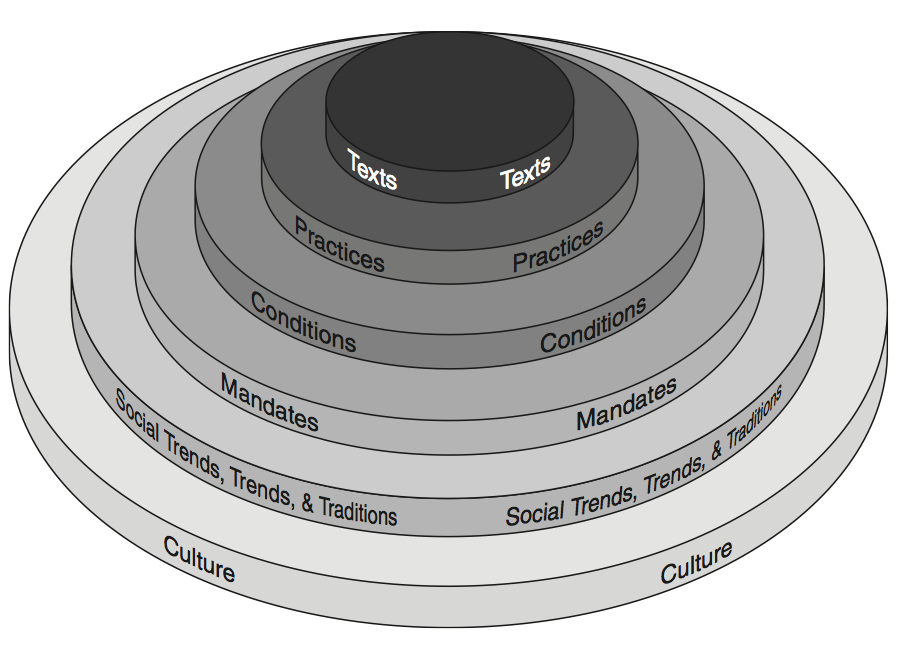
The critical media industry studies approach they espouse instead focuses on the “operations within media industries” and prefers a “helicopter view” rather than a “jet plane” view because it offers “finer detail, albeit with narrower scope” (2009, 239). Havens and Lotz (2012) later introduce “the Industrialization of Culture Framework”, an analytical tool that centres the mandates, conditions and practices that produce media texts. While this framework certainly allows for an understanding of media products as cultural commodities in a capitalist society, the approach lends itself more to the study of individual companies, practices, and processes.
In the Industrialization of Culture Framework, the social changes and history and the social totality central to the political economy approach are contextualised as “Social Trends, Tastes and Traditions” and “Culture”. In this model, such macro concepts provide context for the analysis rather than being the object of analysis.
Janet Wasko and Eileen R. Meehan have responded to these criticisms of the political economy approach on several occasions (Wasko 2018; Wasko and Meehan 2013; Meehan and Wasko 2013). Their main argument is that their critics use generalised straw men when describing their methods, and that there are several examples of the political economy approach being used at all levels of inquiry. They end their article “In defence of political economy” (Meehan and Wasko 2013) by asking if proponents of critical media industries studies simply want to remove the “political” aspect of the political economy approach.
From my point of view, all these traditions/approaches offer important contributions to film and media studies; my work is influenced by all of them to various degrees. Nonetheless, there remain important methodological, ideological, and ethical disagreements between these approaches that will be addressed in the next chapter.
That said, this thesis remains within the tradition of cultural industries studies. There are three main reasons for this. First, it is heavily influenced by Bernard Miège and his understanding of the cultural commodity and cultural industries logics. Secondly, I draw on Hesmondhalgh for much of the analysis, especially his and Amanda Lotz’ concept of “circulation power” (2020). Finally, I believe that the dynamics of the cultural industries are distinct from those of the larger media and creative industries, and that these differences are significant enough to justify cultural industries studies as a separate field.
Defining Cultural Industries
The cultural industries are, at least by Hesmondhalgh and Miège, defined very broadly. Hesmondhalgh’s definition of the cultural industries as “those institutions that are most directly involved in the production of social meaning” (2019, 14), is not fundamentally different from Richard Caves’ definition of “‘creative industries’ in which the product or service contains a substantial element of artistic or creative endeavor” (2000, vii).
Yet in practice Hesmondhalgh and Miège concern themselves with a narrower understanding of the cultural industries. Most of their theories apply only to those parts of the cultural industries where the “artistic or creative endeavor” is not just an “element” of the “product or service”, it is the entire point of the “product or service”.
Hesmondhalg’s reasoning for avoiding the “creative industries” term is mainly political, as he regards it as a pragmatic approach more concerned with policy than critique (2019, 71). I contend that the difference between “creative”, “cultural” and for that matter “media” industries is also categorical.
I prefer a definition of the cultural industries as those industries where “the artist’s imprint” remains even as the product is “reproduced in thousands of copies” (1989, 26). This definition certainly applies to the recorded music industry, publishing, the game industry, the film industry, and most of the television industry. While this definition is narrower than Hesmondhalgh and Miège’s, I argue that it is not only more precise - it also reflects their understanding of the cultural industries better in practice.
Hesmondhalgh argues that the cultural industries are fundamentally concerned with the management and selling of “symbolic creativity”. He uses the phrase “symbolic creativity” and “symbol creators” for two reasons. He wants to avoid the word “art” and its “connotations of genius and higher calling” and to include “those involved in the production and sharing of knowledge as well as of art and entertainment” (1989, 8–9).
Hesmondhalgh includes, in accordance with this broad definition of cultural industries, most if not all media industries including “web design” and “advertising, marketing and public relations” (2019, 15). Miège has a similar understanding of the cultural industries and includes “printed news”, “computer programming” and “live events (including sports events)” (1989, 136).
Further, Hesmondhalgh describes two main stages, creation and circulation, in the social organisation of culture industries. He maintains that a key feature of culture industries is that while those involved in creation have a large amount of autonomy, corporate entities retain strict control over circulation (2019, 95–96).
While this certainly applies to publishing, music, and film, in other industries, such as web design and public relations, or even journalism, workers enjoy far less creative autonomy in their daily work. In these industries, the artist imprint is not necessarily visible or important, and therefore their autonomy is of less value.
In other industries such as arts, architecture and live events that are covered by Hesmondhalgh’s broad cultural industries definition the symbol creators enjoy a large degree of autonomy, but it is more questionable if “corporate entities retain strict control over circulation” (Hesmondhalgh 2019, 96). In these industries the element of reproduction is either limited or a matter of discussion, and they are not sold as cultural commodities, or “reproducible products for private purchases” (1989, 21).
Cultural, and media, goods have unique economic properties that distinguish industries concerned primarily with cultural commodities from those largely selling services – even if those services, like advertising, create symbolic value. Philip M. Napoli offers a concise summary of these unique properties and challenges in his article “Media Economics and the Study of Media Industries” (2009), and his discussion has bearing on challenges film distributors face in negotiating economic value.
Napoli’s first point is that media industries create both content and audiences, and in some markets sell content to audiences and in other markets sell audiences to advertisers. This is the dual product marketplace, where revenue can be generated directly from consumers or from advertising or in a combination of both. The selling of audiences to advertisers is a complex affair, as it is not only difficult to place a value on audience attention, it is also very difficult to measure 1.
Secondly, whether ad-supported or not, cultural/media commodities come with their own unique economic properties. They are, firstly, public goods in the sense that they are not used up when one customer accesses them, but can be consumed again. Additionally, compared to the production costs of the first version, the original film, book or recording, copies can be made at an insignificant cost, resulting in near-zero marginal costs on repeated consumption. Finally, they are also experience goods—their qualities are not known to consumers until they have experienced them 2. Thus, “any consumer that values a media product at a value greater than zero” (Napoli 2009, 165) can generate profit. This makes the value proposition of any given cultural product very difficult both for producers and consumers, resulting in a high level of uncertainty and complex pricing strategies, such as windowing. It also has numerous strategic implications, which will be discussed later in this chapter.
Hesmondhalgh’s stages are also reminiscent of the value chain concept initially introduced by Porter (1985) to identify the competitive advantages an organisation could exploit. Lucy Küng argues that many value chain analyses of media industries in fact do not follow Porter, but are instead a “shorthand means of depicting graphically the various stages by which media products are created and delivered to the customer” (2017, 20).
Yet value chain analysis remains useful in understanding and identifying the companies and processes that make up individual industries. It could also be used to identify what constitutes and separates an individual cultural industry; if companies have a shared/similar value chain, they can be grouped together as part of the same industry. As an example, while the film and television industries both produce stories with moving images and sound, prior to digitalisation they had largely separate value chains. This could be a good reason to consider them separate industries prior to digitalisation, and to reconsider that claim after digitalisation. Still, like a coastline, the value chain becomes longer the closer you look. An overly detailed analysis of the film industry could include road workers, hard drive makers, and coffee plantations as production trucks need roads, cameras need storage, and writers need coffee.
Cultural Industries Logics
The concept of cultural industries logics was introduced by Bernard Miège over several articles in the late 1970s and throughout the 1980s (George 2014; Miège 1989, 1987). Miège used this concept to identify characteristics of cultural industries that were relatively stable through technological change and could also be applied across different cultural industries. Miège’s goal in identifying cultural industries logics was to avoid getting stuck on empirical detail that might not prove relevant in the long run.
Initially, Miège introduced five logics: cultural commodity publishing, “flow” production, printed news, computer programming production and live performing arts (1989, 136). The first three Miège considers established enough to be regarded as models.3
Show the code
miege_models %>%gt() %>%tab_options(column_labels.hidden =TRUE) %>%sub_missing(missing_text ="") %>%tab_source_note(source_note ="The table is reproduced as originally published, see note on translations.") %>%fmt_markdown () %>%opt_table_font(font ="Georgia") %>%tab_style(style =cell_text(weight ="bold"),locations =cells_body(rows =1)) %>%tab_style(style =cell_text(weight ="bold"),locations =cells_body(columns ="...1")) %>%tab_style(style =cell_text(align ="left"),locations =cells_source_notes())
cultural commodities work reproduced in formats conferring a private good character
alternatively, rights of access allowing use of the work
continuous flow accompanied by audience loyalty;information products bought on a regular basis
Main function:
publisher/producer
programmer
editor-in-chief
Sector characterised by:
many small or medium-sized companies clustered around oligopolistic firms
quasi-industrial organisation and emphasis on purchase of rights
industrially organized creation and manufacture
Creative personnel:
remunerated via copyright payments. Existence of incubators (= reservoirs of talent)
generally on salary. Also contract and freelance
generally on salary. Also freelance
Distribution and revenue base:
direct sale to consumer, revenues in proportion to audience size
indirect via license fee/subscription tariff and/or advertising
mixed systems (sales to consumers and advertising receipts
Market characteristics:
segmented mass market
mass market (generally undifferentiated but tending toward segmentation)
mass market segmented or undifferentiated (e.g., newspapers enjoy geographical monopoly
The table is reproduced as originally published, see note on translations.
More expansive versions of the models are presented in the article “New Media, New Questions”. Here, the “dialectic of the hit and the catalogue” as a way of managing risk is included among the market characteristics of the publishing model and “the need to get the attention of the customers and develop their loyalty” is among the market characteristics for the “the written press” model (1989, 146–47)4.
In the intervening decades, Miège and several other theorists have used and developed the cultural industries logics. In these developments the core distinction between the publishing and flow logics has remained central. So has the discussion of whether one or the other is becoming more dominant, or if they are merging (George 2014).
The publishing logic applies to cultural products that are sold or rented on an individual basis, such as a single movie ticket, a single book, a record and so on. The flow logic applies to cultural industries where the consumer does not buy a single product but gets access to a flow of cultural products either through subscription or supported by advertising or subsidies.
Writing in 1987, Miège anticipates the flow model will emerge as dominant but notes that the VCR shows that the publishing model can adapt. He also notes that as cable and local television became more widespread, they would likely increasingly rely on catalogue titles to fill airtime. The flow logic of television would therefore become more like the publishing logic. However, he maintains that even as the flow and the publishing logics become closer, they will remain separate.
In Portals: A treatise on internet distributed television, Amanda Lotz suggests a subscriber model to address streaming services such as Netflix within a Miègeian framework. Lotz argues that these “portals” are distinct from both the publishing and the flow models. Lotz argues that unlike the flow model these portals do not rely on advertising, and unlike the publishing model viewers pay for access to a “package of goods rather than the individual goods” (2017). However, in terms of economic organisation her subscriber model retains elements from both the flow model, large organisations and fixed payments, and the publishing model, irregular and by project employment.
Leslie Meier (2019) discusses how the music industry has always operated simultaneously within a publishing logic, as albums sold to consumers, and within a flow logic, as a principal ingredient in radio broadcasting. Meier argues that while the club or subscriber models might work for some streaming services, depending on their use of advertising or not, “one model cannot capture the complex dynamics of the music industry”. She further argues that “while the non-linear experience of much streaming may be distinct from radio, it does not mark a break from listening practices tied to physical albums” (2019, 328).
These are valuable contributions to the ongoing discussion of cultural industry logics at a time when digitalisation has diminished the differences between the industries, and streaming services seem to be the central business model in all of them. However, neither are fully applicable to the emergence of streaming services within the film industry. Lotz and Meier downplay how the streaming services, especially with their standard autoplay settings enabled, feel like a flow for most consumers most of the time. From a radio or television perspective, this might be minor compared to the newfound possibilities for affecting the flow, but from a film industry perspective this is significant and must be discussed further.
A new streaming logic?
Streaming services challenge the divide between the publishing and the flow logic as formulated by Miège (1987). Recent contributions to the literature highlight to varying degrees elements of publishing logic, such as catalogues (A. Lotz 2017), or elements of flow logic, such as their dependence on loyalty (Johnson 2017).
While streaming services are diverse in their revenue base and market characteristics (Spilker and Colbjørnsen 2020), their content is delivered in the form of a flow. This flow differs from the those in the age of broadcast television described by Miège in that they are not continuous and centrally directed, but interactive and influenced by each individual viewer or listener.
Lotz defines the central function of the portals as “curation”. While this is not significantly different from the “publisher” in Miège’s publishing model, it reflects more precisely how the streaming services present their catalogues. Using a mixture of algorithms and editorial decisions, streaming services present a small selection of their catalogues to the user.
In the interactive flow, the breadth and depth of the catalogue become more important than in the traditional flow logic. Unlike the publishing logic, there is no direct connection between the consumer’s decision to watch a particular film or show, or listen to a particular song, and the larger revenue stream.
In services that pay the creators based on performance – mainly music and audiobooks – there is a connection between the number of plays and the revenue generated to creators. However, this revenue is usually not directly connected to the amount the listener pays to the streaming service, but meted out based on criteria set in the agreement between service and creator.
In services that pay their creators directly – mainly film and television – there is typically no connection at all between what the customer watches and what the creator is paid. All payments from the streaming services tend to be upfront, with no performance bonus. Whether the creators are permanently employed or on a contract basis depends largely on their role in the production company and whether the company traditionally has made television, where salaried employees are common, or movies, where they are rare.
The major streaming services are certainly also mass-market. While they may cater to niche audiences in a way that broadcast television or radio could not, their business model depends on reaching very large audiences.
Much of Netflix’s success can be attributed to its successful understanding of these logics. Reaching 66% of Norwegian households (Schiro 2021), Netflix is certainly “mass market”, however as its flow is interactive it can still appeal to local audiences with local language movies, to niche audiences such as anime fans, or simply the person you want to be tomorrow.
In the traditional flow logic – and also in the sense that Raymond Williams (1975) used flow to describe the way TV programmes fit together – the most important thing for a broadcaster is to keep viewers tuned to their channel. This means that a large number of merely satisfied viewers is better than only a few excited viewers, which tends to steer television shows towards a safe middle ground.
But in the interactive flow, it is possible to cater to smaller and more dedicated audiences and larger audiences at the same time. Content that any given viewer has no interest in need only be a minor distraction as long as the algorithms do their job. This creates room for experimentation that can sometimes lead to surprising successes, such as Netflix’s Squid Game(Hwang 2021).
Even content that is not watched can create value in the streaming logic. High-profile artistic movies such as Roma(Cuarón 2018) might create audience loyalty because viewers want to see it at some future date, even if they right now choose another episode of the humorous cooking show Nailed it!(Starkman 2018).
Still, the interactive flow is first and foremost a flow and requires a constant stream of new content. This necessitates enormous volumes of cash flow, and that is only sustainable with large audiences. In the streaming logic, the oligopolistic tendency of the flow logic appears to be even stronger. We see that it is not enough to be a Hollywood major to be able to compete on a global scale, and that local services either fold or expand to form regional oligopolies.
Thus, while a mass-market streaming service can offer a greater variation in content than the traditional mass-market broadcaster, this comes at the cost of increased concentration on the business side. Consequently, the streaming logic can lead to decreased variation in content globally, and not only in comparison to the traditional publishing logic of movies, but also compared to the internationally fragmented flow logic of traditional television.
In the end there is no need to elevate the streaming logic to a model, in Miège’s hierarchy. In most respects the streaming logic sits well within the flow model, with only minor variations. The larger question is perhaps if the cultural industries logics apply to companies where the sale of access to cultural goods is secondary to the sale of smartphones or free delivery, or companies that measure their success on how Wall Street evaluates their catalogues rather than their potential customers. However, even in these cases the “flow” of content designed to create “loyalty” (Miège 1987, 286) is likely to remain crucial.
Cultural Industry Strategies
Bernard Miège argues specifically that the cultural industries logics are not strategies. The logics are, rather, long-term trends that provide “the basis on which strategies are evolved” (Miège 1987, 284). He argues, however, that central to the publishing logic is the need to reduce uncertainty. Indeed, reducing the high levels of risk and uncertainty inherent in cultural commodities is defined as central characteristics of cultural industries strategies across the field (Hesmondhalgh 2019; Havens and Lotz 2017; Caves 2000; Napoli 2009).
Henry Mintzberg argues that often what is viewed as strategy is frequently the “process of making strategy,” and that strategy is often assumed to be focused on change because change is difficult, and the study of change is interesting. In fact, Mintzberg contends: “Strategy is a force that resists change, not encourages it”. According to Mintzberg, strategies are about creating consistency and reliability. “Strategies reflect the result of organizational learning, the patterns that have formed around those initiatives that have worked best” (1987b, 30).
Common cultural industry strategies
Looking at existing literature, we find several established risk reducing practices across the cultural industries. While the labelling of these as strategies is disputed – some would argue that these are business models, market characteristics, traditions, or practices – I believe it is productive to view them as strategies according to Mintzberg’s definition. An important reason for this is, as this thesis will show, that what are often described as industry-wide practices really only apply to the major companies in the major markets.
From existing literature, I have identified the following common strategies:
overproduction
increased production value
heavy marketing
vertical integration
bundling
comps
windowing
exploiting talent pools
Over-production is to compensate for the uncertain value of a cultural good by producing a high volume of goods. The marginal reproduction costs of cultural goods allow a big hit to compensate for many losses. Though this strategy is described as common across all cultural industries, it is more frequent and more effective in the publishing and music industries, where first copy costs can be very low.
Increased production value raises audience expectations, but also necessitates higher budgets and effectively creates a barrier to entry for companies with less funding. This strategy is most evident in the television, film, and computer games industries, where the increased spend is clearly evident for the consumer. Hollywood has effectively used this strategy to reduce foreign competition since WWI (Segrave 1997, 11). Currently there is also a high-stakes spending war among the SVOD services, that certainly implies that they believe more expensive content is a way to attract viewers (Maas 2022).
Increasing production value is also a strategy aimed at creating positive spirals for oneself and negative spirals for competitors in dual product marketplaces. Dual product marketplaces are partially or solely dependent on advertising, and the relationship between increased circulation and increased advertising revenue tends to create positive or negative spirals. Publications/channels with high impact get more advertising (and subscription) revenue, allowing for higher investments in content, which in turn increases circulation. A publication that loses advertisers, loses revenue and has to reduce investment in content, which results in declining circulation and further loss of revenue.
Heavy marketing is very effective because of the marginal reproduction costs of cultural products, their high availability, and their nature as luxury goods. Companies with enough resources can use marketing to dominate the marketplace and still be profitable, because this domination results in strong sales. Janet Wasko finds that from 1985 to 2002 marketing budgets for Hollywood movies increased from a third to half of the production budgets (2003, 33). A decade later Stephen Follows (2016) examined 29 Hollywood blockbusters with $100M+ budgets and found that the marketing budgets were about 80% of the production budgets.
Vertical integration is the ownership by the same company/conglomerate of several parts of the value chain. This not only allows the extraction of value from larger parts of the value chain; it also allows greater access to the markets and to content. Prior to 1948 Hollywood studios used their control of the entire process from screenplay to screen to exclude competition from cinemas as well as reduce the bargaining power of the creative talent (Gibson 2022).
Bundling is the practice of selling access to services or content only as a part of a larger deal, such as the block booking requirements of the studio era in Hollywood, where cinemas were required to take less popular titles from a studio in order to get access to the biggest titles. Bundling is also common with subscription services, such as the cable company that only offers popular sports programming as a part of expensive bundles with other programmes. Joanna Gibson also describes SVOD services as “a kind of direct-to-consumer block booking” (2022, 169).
Comps: the uncertain value of cultural goods can also be offset by making cultural products similar to other (popular) cultural products. The term “comps” is taken from Thompson (2013). It is common practice in publishing, where the value of a proposal is projected through comparison with similar published titles. Similar practices exist in the television, film, and computer game industries, where popular content is often followed or emulated.
Windowing is the practice of releasing the same cultural product in several sequential windows in various commodity forms. Films are first released in cinemas, then made available for sale on exclusive streaming platforms before being made available for rent, and then finally sold to non-exclusive streaming platforms. Books are initially released in hardcover editions and later made available as paperbacks. While the sequence and nature of the windows changes, the aim is always to extract the maximum potential revenue for each customer by moving from exclusive and expensive commodity forms to less exclusive and more affordable commodity forms.
Exploiting talent pools, and their cultivation, is another strategic practice. Talent pools arise when working in the cultural industries is considered to have value and meaning beyond the exchange of labour for money. This allows cultural industries companies to recruit labour at reduced cost by drawing on talent trying to break into the business. It also allows companies to offer talent less money in exchange for more autonomy, and vice versa. While the practice in many cultural industries of paying talent mainly in royalties does result in talent taking part in revenue created by hits, it also results in talent carrying the risk of not getting paid in the far more common case of misses.
It is worth noting, however, that all these strategies, with the possible exception of the last three – comps, windowing, and the exploitation of talent pools – require large markets and large resources to be successful. Consequently, they are functional strategies only for the dominant commercial companies; for all others they serve as a barrier to entry.
Strategic resources
The uneven access to strategy is described by Thorsten Hennig-Thurau and Mark B. Houston (2019) as a split between the independent and the commercial. To operate in the commercial sector of the cultural industries, they argue, can be very profitable but requires vast economic resources. Independents, by contrast, are those who can’t or won’t operate in the commercial sector. They cannot expect significant profitability, are motivated by other factors, and require other resources like skills and networks to be successful.
Hennig-Thurau and Houston look to the resource-based theory of the firm to explain the dominance of “a few studios and labels” in entertainment industries. They argue that an organisation’s use of a “distinct set of ‘strategic resources’” is the key to competitive advantage and identify four such resources in the cultural industries:
“(a) financial production and marketing resources, (b) distribution resources, (c) access to or control of creatives and their past works, and (d) technological resources” (2019, 130).
According to Hennig-Thurau and Houston access to these resources create effective barriers to entry as they depended on a combination of economic capital and network effects. Even new entrants that can afford to compete in the commercial sectors of the cultural industries need to prove their value against competitors that already have relations to creatives, distributors, cinemas, stores, and other entities they depend on.
The resource-based theory of the firm has however, been criticised because it in many industries is difficult to pinpoint “distinct” strategic resources (Douma 2017). Nonetheless, the nature of cultural goods makes every product distinct. It is therefore not unreasonable to assume that even the “independents” can have access to some kind of distinct resource.
In Merchants of Culture, John B. Thompson (2013) describes a similar split similar to the “commercial” vs. “independent” in UK and US trade publishing. Using Bourdieu’s theory on forms of capital, Thompson argues that the position of publishers in the market depend on their ability to spend and attain either economic or symbolic capital.
Commercial publishers use their economic capital to acquire and market potential bestsellers, which generate further economic capital. Publishers with limited economic capital may still be successful if they manage to attain symbolic capital, which in this case means that they can attract certain types of authors and readers based on the perceived quality of their output. In much the same way as economic capital, symbolic capital also becomes self-reinforcing. While economic capital may be employed to achieve symbolic capital and vice-versa, a publisher’s main strategy is always to spend and accumulated one or the other.
Applied to the broader cultural industries these dynamics explain why, at least in large markets, most companies tend to have mandates that are either commercial or artistic, to be either very large or relatively small, to either have economic capital as their main resource or have symbolic capital as their main resource. While the output from the big commercial companies tends to dominate markets, the independent/small/artistic companies are always more numerous. It is therefore possible to survive in the cultural industries by applying skills and knowledge to find viable positions in the market that do not require huge financial resources.
In smaller markets the lack of a sustainable market and the importance of policy, will however, make the large and commercial companies more dependent on symbolic capital as well. If their position depends to some degree of public funding, they must prove their value beyond the economic.
Analysing strategies
While the industry-wide practices outlined above can all be viewed as strategy, Mintzberg’s understanding of strategy as a force that resists change is less useful when attempting to understand and analyse the strategies of individual organisations. Mintzberg argues that strategies can be defined, and analysed, in five ways: plan, ploy, pattern, position and perspective.
As plan or ploy, strategy is understood as deliberate – that is, something an organisation intends to do, in the case of a plan, or something the organisation wants others to think it intends to do, in the case of a ploy. As pattern, a strategy is studied not according to an organisation’s intentions, but according to its realisation in past practice. In this scenario, a strategy begins as intended, but in the process of becoming realised, unrealised plans are abandoned and emergent strategies are folded in. Strategy as position addresses how an organisation differentiates itself sufficiently to create “any viable position” (Mintzberg 1987a, 5). Strategy as perspective examines how the organisation views itself and the world.
Strategies can be studied as any combination of these, but in the cultural industries field (as indeed most fields) access to process and strategy documents is limited. Empirical data on realised strategies is, by contrast, discoverable in the form of books published, movies released, records promoted, and so on. Thus, broad analysis of strategy as pattern or position is possible even with access only to public data such as information on books published, records promoted, or movies released. Analysing cultural industry strategies as plan, ploy or perspective requires at the minimum careful attention and at best access to informants, processes, and internal documents.
Responding to Change
One implication of Mintzberg’s understanding of strategy as a force that resists change, is that when change eventually occur “then all that is constructive and efficient about an established strategy becomes a liability.” (1987b, 31).
Mintzberg, Ahlstrand, and Lampel (2005) argue that cultural industry companies are usually adhocracies. These are companies that because of the constantly changing nature of their industries make constant and incremental changes. On the other hand of the spectrum they place machine bureaucracies. These are companies that tend to resist change as long as possible, before making sudden and sweeping changes.
In examining Norwegian publishers’ responses to digitalisation, Terje Colbjørnsen (2015) applies Christine Oliver’s (1991) typology of strategic responses. Colbjørnsen finds that the publishers were generally on the passive end of the spectrum, often choosing acquiesce or compromise over avoid, defy, or manipulate. Despite the frequent criticisms of both the general slowness of the publishers’ response to digitalisation as well some of their specific efforts, Colbjørnsen finds that their strategies of slow and incremental change succeed in preserving continuity.
As such one should expect cultural industries companies to respond with incremental, if not slow, changes, that more often than not are on the passive end of Oliver’s spectrum. Since they are constantly changing and interdependent, sudden and sweeping changes seldom last. Even a recent act of notable defiance, such as Warner’s abandonment of the cinematic window in 2021 resulted in a compromise – a shortened cinematic window.
Cultural Industries in small countries
If the inherent qualities of cultural commodities favour economics of scale, they not only favour large companies, they also favour large nations. If strategies traditionally seen as key to success in the cultural industry are only available to those with economics of scale, even large companies operating in small countries would find them inaccessible.
In The Cinema of Small Nations,Hjort and Petrie (2007), discuss several possible definitions of small nations. Key to their analysis is the understanding that small is relative – a small nation is small in comparison to one or more bigger nations. In a cultural industries context, a small nation is one where local creation cannot be funded by local dissemination, or where local cultural commodities would be outcompeted by foreign cultural commodities.
In this context, size does not always matter, but language tends to. In the film industry, Canada is a small nation because of the dominant US neighbour. Germany is a large nation in the German-speaking sphere, but a small nation again when compared to the US. Norway is a small nation in almost every definition of the term, but it is relatively bigger in the publishing industry than in the film industry – while the Norwegian publishing industry also relies on policy – governmental financial support and cultural directives – to sustain domestic output, lower production costs and higher language barriers to foreign entry result in a more viable domestic market than in the film industry.
Policy is, in fact, critical to sustaining small nation cultural industries. Governmental interventions range from various degrees of support of local industries and protections against foreign industries.
Hjort and Petrie find that governmental interventions in the film industries of small nations three main goals: political, cultural, or commercial. A political intervention seeks to build, or protect, national identity and could serve as propaganda or censorship. A cultural intervention seeks to nurture film for their importance as art. A commercial intervention seeks to compensate for the lack of a local market, either by supporting popular local movies in the home markets or by supporting exports to larger markets.
In Norway we find traces of all three in both film policy as well as in the broader media and cultural policy. As an example the Norwegian public service broadcaster, NRK, has obligations to be popular and to unite the nation, while also supporting all segments of the population, no matter how small (Syvertsen et al. 2014).
The problem with digital “availability”
Digitalisation has affected all the cultural industries as it has changed the production, the commodity form, the distribution, and the consumption of cultural products. At the advent, digitalisation was seen by some scholars5(Hesmondhalgh 2019, 264) an opportunity for far more diverse cultural offerings.
The belief that digital platforms could have a more diverse offering was based on their potentially unlimited storage space. The reality has been that financial, legal and technological aspects of digital distribution reduces diversity.
Hesmondhalgh and Lotz identify the interfaces of these platforms as key sites of “circulation power”. They note that being in the library of such platforms “means relatively little” if the content is not given “discoverability” and prominence” (2020, 389). Building on Hesmondhalgh’s earlier work (Hesmondhalgh 2019) they explain that “circulation power [refers] to the powers that media industry firms involved in production and circulation can exert over creators, audiences and the media environment in general” (2020, 389).
Hesmondhalgh and Lotz use circulation power to explain why falling production costs6 have not led to a significant increase of “alternative” producers in cultural markets: smaller producers still lack access to “key sites of circulation”. The concept of circulation power also has bearing on information about viewership and prominence, which prior to digitalisation was generally available, if not to the public then at least to creators. By contrast, streaming services have generally kept this information secret for their own strategic advantage (2020, 390)
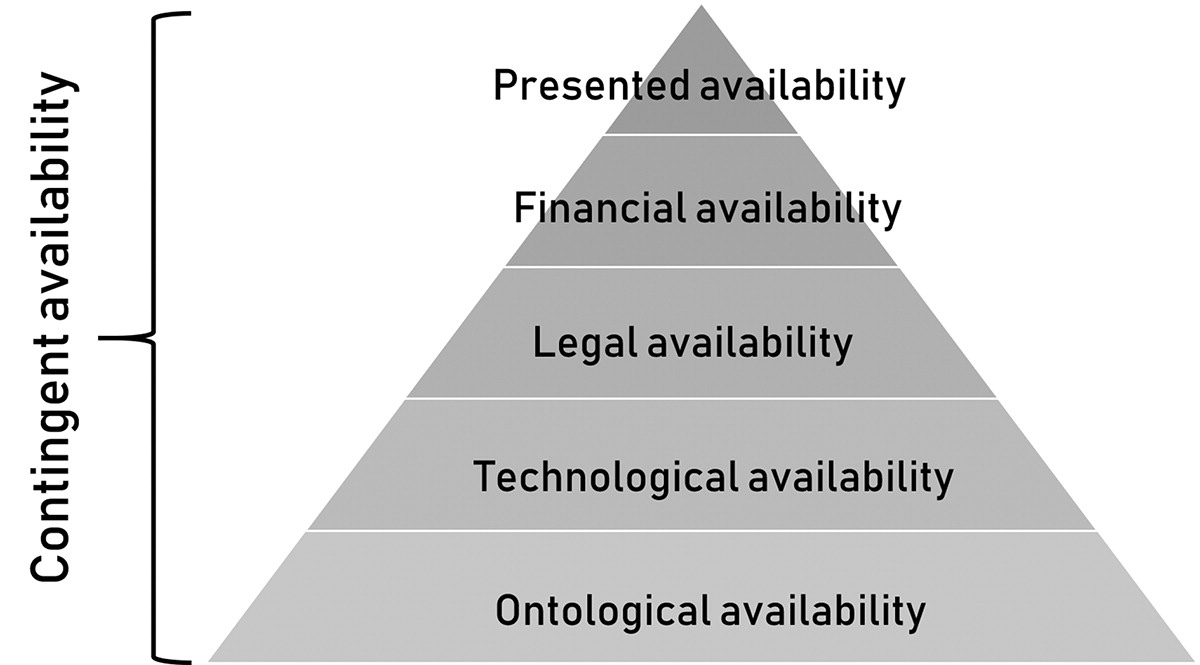
However, while the libraries of digital platforms are virtually unlimited, content still has to pass several hurdles in order to be included. The availability pyramid, a concept developed by Terje Colbjørnsen, Kim Tallerås and me (2021), aims to clarify the contingencies that the availability of cultural products rests on. We argue that for any cultural product to be presented to the consumer, it has to exist, it has to be in an accessible format, legal issues must be solved, and economic issues have to be solved.
When previously released cultural products become unavailable they have more often than not been caught in one or more of these issues. New technologies will always pose a risk for older content, as their legal standing might have become unclear since the last release or their economic value might not warrant a new release. Even a movie that remains in print on an older format, such as a DVD, will gradually less available as audiences move on to new platforms.
Amazon and Netflix were among Chris Anderson’s (Anderson 2006) exemplars of the long tail, the digital stores with unlimited storage. Philip M. Napoli (2019) re-examines Anderson’s ideas to understand why the long tail never happened. In the case of Netflix and similar streaming services, Napoli finds that for Netflix licensing fees simply became too expensive to be sustainable, and that original content is a better long-term strategy.
In terms of the availability pyramid Netflix’ Originals’ strategy secures both the long-term legal and economic availability for content, and licensed content will have a more difficult path across these hurdles. In our first article on the contingent availability concept we also find that Netflix seem to give higher prominence7 to their own content (Tallerås, Colbjørnsen, and Øfsti 2019).
Napoli argues one step further along similar lines. When Netflix became a content creator, it suddenly had incentives to reduce the size of the library. “[O]nce a content aggregator vertically integrates into content creation, all of the unaffiliated, licensed content available on the service represents a competition to the home-grown content” (Napoli 2019, 92).
Using Amazon’s acquisition of MGM as a focal point Johanna Gibson (2022) discusses how SVOD services are increasingly locking a significant share of cultural heritage inside their walled gardens. She further argues that their focus on exploiting existing brands and properties is a threat to creativity and comes at the expense of independent artists.
However, Hesmondhalgh and Lotz’ argument that simply being in the libraries of these platforms “means relatively little” still stands. While platforms might be able to store vast amounts of content on their servers, they have very limited screen space to display available visual content. Compared to a physical store or a theatre, far less content will typical fit in the most prominent places. As prominence is relative this increased the prominence of featured content, at the expense of other.
In many respects, the digital store is like a “serviced store”; while display space is limited, more content exists in storage than in the self-service store because there is no need for it to be accessible to customers. If the customer wants something “from the back,” they must either know what they are looking for or trust the store’s recommendations. In most cases these recommendation systems are based on what is already popular (Bobadilla et al. 2012).
All of this affects content from independent producers and small nations. With smaller initial markets they struggle for prominence in digital recommendation systems, with less resources at hand they lack the circulation power to cross technological, legal, and economic hurdles to availability and prominence. Within their SVOD services, however, companies like Netflix, Disney and Warner can dictate the terms of prominence and availability at their own will.
The problem with “distribution”
The digitalisation of the cultural and media industries has also caused a surge in scholarly interest in questions of distribution. Alisa Perren found that while there were perhaps more studies on media distribution than she expected, the field was fragmented and lacked standardised definitions that would enable cross-industry analysis. Perren calls for more “comparative approaches (…) under the broader heading of ‘Distribution Studies’” (2013, 169).
With the release of the anthology Digital Media Distribution: Portals, Platforms, Pipelines(McDonald, Donoghue, and Havens 2021), this call has certainly been heeded, even if the editors are reluctant to call “distribution studies” a field. Nevertheless, the anthology as well as numerous other studies of film and television distribution published since 2013 show a healthy interest in distribution from various media industry perspectives.
Virginia Crisp finds that “distribution” is a poor description of what film distributors actually do. She briefly mentions that Paul McDonald, who in turn cites Henrik Vogel, argues that “publishing” might be a better term. (Crisp 2015, 1). Lotz also discusses how the classic separation of the film industries into production, distribution and exhibition became awkward as soon as film consumption expanded beyond cinemas (2021, 50).
Joshua A. Braun argues against using industry-defined actor categories for several reasons. They are not necessarily precise, they are seldom applicable across industries, and the previously stable borders between categories are disappearing. Braun instead prefers definitions that centre the process of distribution as “‘movement of content from the time it is produced to the time it reaches the consumer’” (Braun 2015) in (Braun 2021, 29).
This is reflected throughout the contributions to Digital Media Distribution, where the various definitions of distribution tend to focus on the process/practice.
“Whether we call it”circulation,” “valuation,” or “consumer intelligence,” the practices of evaluating potential markets for media products, setting production and intellectual property rights costs, ensuring that targeted consumers know about and have access to the products, and evaluating their success are necessary for all contemporary media corporations, regardless of what we might call these practices.” (McDonald, Donoghue, and Havens 2021, 8).
While these broad, process-oriented definitions of distribution are useful when examining the spread of media or general industry practices, they are less useful when examining what distributors actually do. According to Lotz,“the tasks attributed to the role of ‘distributors’ are too broad and varied to lead to useful theory” (2021, 59).
Echoing Hesmondhalgh’s (2019) “creation” and “circulation” stages, Lotz replaces the distinctions between production, distribution, exhibition with “production” and “circulation”. Lotz further analyses “the tasks of circulation” within the context of television in the U.S., identifying how tasks such as “create”, “fund”, “organize”, and “deliver” are performed. A key argument for Lotz is that a task-based framework “identifies the many entities that may engage in both distribution (select, coordinate) and exhibition (offer)” (2021, 49).
The task-based framework also allows for analysis of production/circulation without having to define the actors as a part of any given cultural industry or not – something Hesmondhalgh’s model forces him to discuss in several instances (2019, 20). The question, then, is not whether a company is a cultural industry company, but whether or not it performs a task within the cultural industries. For instance, Hesmondhalgh does not consider Walmart to be a cultural industry company. However, as a major retailer of movies, books, games, and music it has, or used to have, a major impact on which culture products are sold at large scale in various global markets. It would therefore be wise to use an analytical model that allowed for Walmart’s impact as a retailer.
Lotz does not define the role of her task-based framework beyond the examples listed above. This makes the framework very flexible and able to discover and analyse changes in production and circulation as new tasks emerge. On the other hand, without a set of defined tasks it might be too specific to allow cross-industry analysis.
The “circulation” concept is, on the other hand, often simply too broad to be useful. There is a significant distinction between “production”, “creation” and “circulation”, especially, as Hesmondhalgh notes, when it comes to the amount of control the major cultural industry companies exert. But “circulation” also covers very different kinds of activities that are sometimes even at odds with each other – for example, when film distributors and exhibitors wrestle over window-length and rental fees.
In the next few pages I therefore propose a new theoretical framework, the cultural industries functions, consisting of creation, commodification and dissemination.
This framework is similar to Lotz’ task-based framework in that it centres what tasks/functions are performed, rather than who performs them. However, it also employs strict theoretical definitions of these functions. This allows for easier cross-industry and longitudinal analyses.
The framework resembles Hesmondhalgh and Lotz’ stages but returns to a tripartite structure. There are several reasons for this. One is that they have very different relations to those in the creation function. Retailers, exhibitors, and others in the dissemination function rarely interact directly with the creation of films, books, games, and so on. Powerful retailers like the aforementioned Walmart have demonstrably had an impact on what kinds of culture products are made, but this influence is channelled through distributors, publishers, labels, and other intermediaries.
Further, both currently and historically, dissemination has been an important entry point for major players within cultural industries. Netflix, Spotify, and most of the major Hollywood studios started their businesses by selling subscriptions or tickets directly to customers before they, to varying degrees, moved into commodification and creation. By considering dissemination as a discrete function, identifying such moves is easier.
Most retailers/exhibitors are also not involved in the commodification of culture goods. When the film reaches the cinema, or the book reaches the bookstore it is in most cases as a finished, commodified product. The only things left to negotiate are how, when and at what cost the product is sold. Separating commodification and dissemination thus allows for analysis of the power struggles between retailers and publishers, cinemas, and distributors, and so on.
Cultural industries functions
Creation in the cultural industries functions framework entails the creation of texts. Commodification is the conversion of texts into cultural commodities that can be disseminated on an industrial scale. Dissemination is the extraction of revenue from cultural commodities on an industrial scale through sales, exhibition, or other means.
While not all three functions need to be present for cultural production to take place, they are all required to make a cultural industry. It is easy to imagine a writer creating texts that are never commodified nor disseminated, and simply left as forgotten files on forgotten computers. This does not generate any readers or revenue and as such is not an industry. One could argue that an artist performing music solely at self-booked gigs and selling their homemade records directly to the audience is enacting creation and dissemination without commodification. However, this scenario cannot be replicated on an industrial scale and so also does not form the basis of a cultural industry.
The creation function is performed by those who are directly involved with the creation of a text – in the publishing industry, writers, and in the music industry, artists. Yet this process quickly becomes less self-explanatory. Where does creation end in complex cases such as the movie industry? Writers, directors, and actors obviously perform the creation function, but what about lighting technicians and the make-up department? In most cases though, this level of distinction is unnecessary; it is sufficient to identify creation based on its relationship with commodification function. Simply put, who is compensated when the text becomes commodity? In most cases it would be sufficient to consider production companies as performing the creation function in film and television, as they have direct dealings with performers of the commodification function.
The commodification function is the process of turning text (the output of the creation function) into cultural products that can be disseminated on an industrial scale. Commodification creates or changes the commodity form of the text.
While commodification can take many forms across industries and at different times, the constant factor in commodification is the management of intellectual property rights. The core business of the entities that perform the commodification function is the buying, selling, and managing of rights. The latter includes making physical and digital copies available for dissemination, and in most cases making the overreaching marketing decisions. Commodification can also change the commodity form of the cultural product as it moves through various markets, windows, and formats.
In the book and games industry, publishers perform the commodification function; in the movie industry, it is the domain of the distributors; and in the music industry, it is handled by record labels. While companies at the dissemination level participate in marketing, they typically do so with support and materials provided by companies involved in commodification.
The dissemination function takes place at the actual point of sale, rent or other forms of monetisation of the text. This encompasses sales in online or physical stores, exhibition in cinemas, subscription services and/or ad-supported outlets like social media or free-to-air television. Dissemination does not change the commodity form of the cultural product.
The conversion of texts into cultural products that can be disseminated on an industrial scale.
Dissemination
The extraction of revenue from cultural products through consumers.
These three functions are specific enough to be analytically useful, while remaining general enough to allow cross-industry analysis. The framework could, for instance, highlight the power struggles within the various industries and the centrality of the commodification function.
Commodification, unlike creation and dissemination, is by definition an industrial process. Commodification creates products that can be sold, rented, or otherwise monetised by the thousands and thousands. It is when creation and dissemination are connected with commodification that they become a part of a cultural industry. If the creation or the dissemination is performed in a way that cannot be scaled it is not industrial, but artisanal. The professional writer, paid for his books and not employed by the church or other patrons, could not exist without the publisher and the printing press (Feather 2005).
The commodification function has therefore always been the most capital intensive of the three functions, and therefore commodification has often also been gatekeeping. Often by design as reducing any competition’s ability to put products in the marketplace is an obvious way to your own success.
Thus artist, writers and others performing the creation function have always risked exploitation by the often more powerful publishers, labels and others that perform the commodification function. On the other hand stores and others performing the dissemination have banded together in chains to give themselves more negotiation power vs. the publishers and distributors.
Creation happens once. Even if some kinds of text, like a successful TV shows, the text is at some point finished. Any later revisions of the text after it has been released is a new text8. Dissemination happens constantly. Though most cultural products have short shelf-lives, there is no limit to the number of times any given cultural good can be consumed. Commodification happens sequentially as the commodity form is adapted to new technologies, new windows, new markets, and so on.
While the text and the commodity form are not the same, as I argue further later in this chapter, in terms of the cultural industries functions, the text is finished when it is first commodified. Until the book, the record or the movie is available to the public it can still change. The first performance of the commodification function is therefore crucial. It not only “finishes” the text and makes it available as a product, the commodity properties a cultural product is given when first commodified will tend to remain in subsequent commodity forms.
When discussing the film industry, there is therefore good reason to separate first run distributors and sub-distributors. The term first run distributor is here borrowed from Amanda Lotz and a discussion on the financing of television versus streaming (2019). First run distributors perform the first commodification, typically acquiring distribution rights for a film when it is in the early stages of pre-production. In film, as well as television, the first run distributor tends to contribute a critical part of the financing as well as create the initial marketing campaign. Sub-distributors, a term here borrowed from my informants, acquire rights to movies that already exist in a commodity form, and adapt that commodity from to whatever market they have acquired rights for. In many cases the changes to the commodity form are minimal, such as the adding of subtitles or choosing another poster.
Still, the cultural industries functions are theoretical constructs. In practice the divisions between them are blurry, because most companies and individuals perform two or more of the functions at various stages. This is especially true of creation and the first point of commodification, first run distributors that invest in unfinished films are involved in creation.
Analysing Norwegian streaming services
As an example, an analysis of the leading book, film, and music streaming services in Norway using the cultural industries functions would look like this:
Table 1.3: Major book, music, and film streaming services in Norway
Function
Publishing Industry
Music Industry
Movie Industry
Creation
Writers, Cappelen Damm
Artists
Production companies, Netflix
Commodification
Cappelen Damm
Labels
Distributors, Netflix
Dissemination
Storytel
Spotify
Netflix
The Norwegian (audio-)book streaming market is currently dominated by Storytel. Storytel gives subscribers access to a catalogue of audiobooks and ebooks. Storytel does not pay the authors upfront for streaming rights, but pays out royalties based on the popularity of each title. In other words, the company performs the dissemination function.
This is, however, complicated because Storytel is partly owned by the publisher Cappelen Damm, and most of the books on the service are titles from the Cappelen Damm catalogue. Cappelen Damm itself mainly performs the commodification function because its core business is buying intellectual property rights from writers and transforming these into goods or services that can be sold in, among other places, bookstores and Storytel. However, Cappelen Damm is also directly involved in the creation function as the company’s editors often work closely with writers and often commission books.
In the music streaming market, Spotify is the largest player in Norway. Like Storytel, Spotify does not buy any rights – music, in this case – and payments to artists are paid after the fact based on the number of plays for each track9. Although the service has radically transformed the music industry as a whole, it is currently not directly involved in either the commodification or the creation of music[^20]. If Spotify, like Storytel, was owned by a major recording label and almost exclusively offered tracks from that label, the service would be very different.
When Netflix was a company that rented out DVDs by mail, it was only performing the dissemination function10. Because of the US first-sale doctrine, Netflix did not need to buy any rights for the movies in their catalogue, only the physical copies already available in the market. When Netflix became a streaming company, however, it had to buy streaming rights from producers and other distributors and thus began performing the commodification function as sub-distributor.
After this move, it didn’t take long for Netflix to start producing its own content and so became a vertically integrated company that performed all three functions, in a manner that mirrors the development of the early Hollywood studios (Keating 2013; Gomery 1992). Currently, the Netflix catalogue consists of titles where it, as sub-distributor, has acquired screening rights limited by time and territory from other distributors or production companies and titles where Netflix as a first distributor has either bought all distribution rights or even commissioned the content11.
We can also use the figure above to address the various power struggles within the industries. In our study of availability in Norwegian streaming platforms, we found that books published by Cappelen Damm were clearly overrepresented among those with highest prominence on Storytel (Tallerås, Colbjørnsen, and Øfsti 2019). By which mechanisms this happened in an otherwise very regulated Norwegian book market must remain speculation. However, as the owner of the streaming service they could for instance consider the costs of audio recordings a necessary expense to bolster the service and drive subscriptions, where an outside publisher would have to consider the cost of any recording against the potential streaming revenue for each title.
Table 1.3 also demonstrates why Spotify’s position and the music streaming market is quite different from Storytel and Netflix’. Does this also mean that Spotify has less influence? The company is by no means powerless, as demonstrated by the labels and artists that have reluctantly joined the platform in the last few years despite publicly complaining about Spotify’s payment models. However, unlike Netflix or Storytel, Spotify has to compete with the other streaming services in its industry on a far more level playing field. Despite Tidal and Apple’s attempts, there has been no successful implementation of exclusive deals in the music streaming market. However, Spotify has bought exclusive rights to podcasts such as The Joe Rogan Experience, which does make it a podcast publisher who perform the commodification function in that market.
If we were to add digital sales/rental platforms like iTunes to Table 1.3, it too would occupy a similar position as Spotify. Regardless of whether iTunes sells movies, books, or music, it acts simply as a dissemination point. All rights are retained with publishers, distributors, artists etc. and every sale/rental generates a cut for both iTunes and the rights’ holder.
The Cultural Commodity
The cultural industries functions also allow for a more thoughtful understanding of the cultural commodity. Since the term was introduced by Horkheimer and Adorno ([1947] 1991), there has been little discussion about what the commodity form of cultural goods actually is. Napoli (2009) and others discuss the market properties of the cultural commodity, but not its form. Miège gives a succinct description of the cultural commodity when he describes the inherent contradiction of the need for the unique “artist imprint” while remaining “reproducible in the thousands” (Miège 1989, 26).
I contend that the commodity form of the cultural product is the sum of properties of the product that makes it possible to generate revenue on a large scale. Cultural commodities in each market therefore tend to have the roughly same physical dimensions, allowing them to be stacked together in shelves, for example, or to use standardised file formats, or allowing them to be reproduced on the same hardware. They might be roughly the same length of time, allowing them to be grouped in a schedule.
When considered through the cultural industries functions framework, standardisation in genres, in marketing, pricing and so on are also requirements for the dissemination of cultural products on an industrial scale, and therefore a part of the commodity form. One could even argue that modern intellectual property law turns ideas into commodities by their very existence. The legal protection of the uniqueness, of the “artist’s imprint” of any given cultural commodity, is the first building block of the cultural industries.
Of course, the relationship between the commodity form and the “artist’s imprint” varies from industry to industry, from market to market and between individual products. While publishers generally switch covers for novels not only between markets, but also between editions, record companies rarely change album covers. In other words, an album cover is a part of the text, a part of the artist’s imprint, while a book cover is simply something that sells the book. While the text is never available to the general public in a non-commodity form – and it could be argued that some commodity properties such as genre are imbued even in text creation – the commodity form and the text of the cultural product are not the same.
Frozen(Buck and Lee 2013) remains the same text whether it is seen in theatres, on Blu-ray or on Disney+ even if the commodity form changes. Homer’s Odyssey remains the same text whether it is published in a blue and gold hardcover with classical Greek artwork on the front or in paperback editions with George Clooney’s face on the cover and marketed as “the story behind O’Brother where art thou?”.
That is not to say that commodification is in any way a neutral process. The difference between creation and commodification is one of intent. The localisation of Frozen involves a number of artists that translate and record local language versions. However, the intent of localisation is not to create a new movie, but to sell Frozen in more markets.
In the most industrial and commercial end of the cultural industries the commodity form of the text can even be said to predate the actual text. At the time of writing there are several “Untitled Marvel” films and television shows upcoming - one even with a set release date that will pass before this thesis is published. The commodity form is already built, and all that is left to the creators is to furnish it with text.
References
Anderson, Chris. 2006. The Long Tail: Why the Future of Business Is Selling Less of More. New York: Hyperion.
Bobadilla, Jesús, Fernando Ortega, Antonio Hernando, and Jesús Bernal. 2012. “A Collaborative Filtering Approach to Mitigate the New User Cold Start Problem.”Knowledge-Based Systems 26 (February): 225–38. https://doi.org/10.1016/j.knosys.2011.07.021.
———. 2021. “Points of Origin: Asking Questions in Distribution Research.” In Digital Media Distribution: Portals, Platforms, Pipelines, edited by McDonald, Paul, Donoghue, Courtney Brannon, and Havens, Timothy. Critical Cultural Communication. New York: University Press. https://doi.org/10.18574/nyu/9781479806812.003.0006.
Buck, Chris, and Jennifer Lee. 2013. “Frozen.” Animation, {{Adventure}}, {{Comedy}}. Walt Disney Animation Studios, Walt Disney Pictures.
Caves, Richard E. 2000. Creative Industries: Contracts Between Art and Commerce. Cambridge, Mass. [u.a.]: Harvard Univ. Press.
Colbjørnsen, Terje. 2015. “Continuity in Change: Case Studies of Digitalization and Innovation in the Norwegian Book Industry 2008-2012.” PhD thesis, Oslo: Faculty of Humanities, University of Oslo.
Colbjørnsen, Terje, Kim Tallerås, and Marius Øfsti. 2021. “Contingent Availability: A Case-Based Approach to Understanding Availability in Streaming Services and Cultural Policy Implications.”International Journal of Cultural Policy 27 (7): 936–51. https://doi.org/10.1080/10286632.2020.1860030.
Crisp, Virginia. 2015. Film Distribution in the Digital Age: Pirates and Professionals. Basingstoke, Hampshire: Palgrave Macmillan. https://doi.org/10.1057/9781137406613.
George, Eric. 2014. “The Theory of the Cultural Industries: A "Millieu" for Building Dynamic Knowledge” 39: 29–54.
Gibson, Johanna. 2022. “Choose Your Plan: Amazon’s Acquisition of MGM and the Streaming Wars for Our Cinematic Heritage.”Queen Mary Journal of Intellectual Property 12 (2): 165–71. https://doi.org/10.4337/qmjip.2022.02.00.
Gomery, Douglas. 1992. Shared Pleasures: A History of Movie Presentation in the United States. Wisconsin Studies in Film. Madison, Wis: University of Wisconsin Press.
Gripsrud, Jostein. 2000. “Learning from Experience: Cultural Policies and Cultural Democracy in the 20th Century.”International Journal of Cultural Policy 7 (2): 197–209. https://doi.org/10.1080/10286630009358142.
Havens, Timothy, and Amanda D Lotz. 2017. Understanding Media Industries. Second edition. New York ; Oxford University Press.
Havens, Timothy, and Amanda D. Lotz. 2012. Understanding Media Industries. New York: Oxford University Press.
Havens, Timothy, Amanda D. Lotz, and Serra Tinic. 2009. “Critical Media Industry Studies: A Research Approach.”Communication, Culture & Critique 2 (2): 234–53. https://doi.org/10.1111/j.1753-9137.2009.01037.x.
Hennig-Thurau, Thorsten, and Mark B Houston. 2019. Entertainment Science: Data Analytics and Practical Theory for Movies, Games, Books, and Music. Cham, Switzerland: Springer.
Hesmondhalgh, David. 2019. The Cultural Industries. Fourth edition. Los Angeles: SAGE.
Hesmondhalgh, David, and Amanda D Lotz. 2020. “Video Screen Interfaces as New Sites of Media Circulation Power.”International Journal of Communication 14: 386–409. https://ijoc.org/index.php/ijoc/article/view/13261.
Hjort, Mette, and Duncan J. Petrie. 2007. The Cinema of Small Nations. Edinburgh: University Press.
Horkheimer, Max, and Theodor W. Adorno. [1947] 1991. Kulturindustri: opplysning som massebedrag. Translated by Arne Sundland. 2. utg. rev. oversettelse ved Arne Sundland. Cappelens upopulære skrifter. Oslo: Cappelen.
Johnson, Catherine. 2017. “Beyond Catch-up: VoD Interfaces, ITV Hub and the Repositioning of Television Online.”Critical Studies in Television 12 (2): 121–38. https://doi.org/10.1177/1749602017698159.
Keating, Gina. 2013. Netflixed: The Epic Battle for America’s Eyeballs. [New ed.]. New York, N.Y: Portfolio/Penguin.
Küng, Lucy. 2017. Strategic Management in the Media: Theory to Practice. 2nd ed. London: Sage.
Lotz, Amanda. 2017. Portals: A Treatise on Internet-Distributed Television. Ann Arbor, MI: Michigan Publishing, University of Michigan Library. http://hdl.handle.net/2027/spo.mpub9699689.
Lotz, Amanda D. 2019. “Teasing Apart Television Industry Disruption: Consequences of Meso-Level Financing Practices Before and After the US Multiplatform Era.”Media, Culture & Society 41 (7): 923–38. https://doi.org/10.1177/0163443719863354.
———. 2021. “In Between the Global and the Local: Mapping the Geographies of Netflix as a Multinational Service.”International Journal of Cultural Studies 24 (2): 195–215. https://doi.org/10.1177/1367877920953166.
McDonald, Paul, Courtney Brannon Donoghue, and Timothy Havens, eds. 2021. Digital Media Distribution: Portals, Platforms, Pipelines. Critical Cultural Communication. New York: University Press.
Meier, Leslie M. 2019. “Popular Music, Streaming, and Promotional Media: Enduring and Emerging Industrial Logics.” In Making Media: Production, Practices, and Professions, edited by Mark Deuze and Mirjam Prenger, 321–34. Amsterdam: Amsterdam University Press. https://doi.org/10.1515/9789048540150-024.
Miège, Bernard. 1987. “The Logics at Work in the New Cultural Industries.” Translated by Johnatan Davis. Media, Culture and Society 9: 273–89.
———. 1989. The Capitalization of Cultural Production. New York, N.Y: International General.
Mintzberg, Henry. 1987a. “The Strategy Concept I: Five Ps For Strategy.”California Management Review 30 (1): 11–24. https://doi.org/10.2307/41165263.
———. 1987b. “The Strategy Concept II: Another Look at Why Organizations Need Strategies.”California Management Review 30 (1): 25–32. https://doi.org/10.2307/41165264.
Mintzberg, Henry, Bruce Ahlstrand, and Joseph Lampel. 2005. Strategy Safari: A Guided Tour Through the Wilds of Strategic Management. New York: Free Press.
Mosco, Vincent. 1996. The Political Economy of Communication: Rethinking and Renewal. The Media, Culture & Society Series. London [u.a.]: Sage Publ.
Napoli, Philip M. 2009. “Media Economics and the Study of Media Industries.” In Media Industries: History, Theory, and Method, 161–70. Malden, Mass: Wiley-Blackwell.
———. 2019. “Re-Evaluating the Long Tail: Implications for Audiovisual Diversity on the Internet.” In Audiovisual Industries and Diversity, edited by Mª Trinidad García Leiva and Luis A. Albornoz, 1st ed., 85–99. Routledge. https://doi.org/10.4324/9780429427534-5.
Oliver, Christine. 1991. “Strategic Responses to Institutional Processes.”The Academy of Management Review 16 (1): 145–79. https://doi.org/10.2307/258610.
Perren, Alisa. 2013. “Rethinking Distribution for the Future of Media Industry Studies.”Cinema Journal 52 (3): 165–71. https://doi.org/10.1353/cj.2013.0017.
Porter, Michael E. 1985. Competitive Advantage: Creating and Sustaining Superior Performance. New York: Free Press.
Schiro, Emma Castillo. 2021. “Norsk mediebarometer 2021,” 128.
Segrave, Kerry. 1997. American Films Abroad: Holywood’s Domination of the Worlds Movie Screens from the 1890’s to the Present. Jefferson, N.C: McFarland.
Spilker, Hendrik Storstein, and Terje Colbjørnsen. 2020. “The Dimensions of Streaming: Toward a Typology of an Evolving Concept.”Media, Culture & Society, 016344372090458. https://doi.org/10.1177/0163443720904587.
Syvertsen, Trine, Ole J. Mjøs, Hallvard Moe, and Gunn S. Enli. 2014. The Media Welfare State: Nordic Media in the Digital Era. The New Media World. Ann Arbor: University of Michigan Press.
Wasko, Janet, and Eileen R. Meehan. 2013. “Critical Crossroads or Parallel Routes?: Political Economy and New Approaches to Studying Media Industries and Cultural Products.”Cinema Journal 52 (3): 150–57. https://doi.org/10.1353/cj.2013.0028.
Williams, Raymond. 1975. Television: Technology and Cultural Form. New York: Schocken Books.
Napoli was, in 2009, mainly considering television audiences that were roughly measured by rating companies. In a world of on-line advertising many ad-companies offer very granular audience measurement. However, the credibility of such measurements is questionable (Read 2018).↩︎
Napoli does not use the term “experience goods”, but argues along the same lines as Caves’ (2000) use of the term.↩︎
The translation of The Capitalization of Culture Production(Miège 1989) uses the terms publishing, flow and printed news when the logics are presented, but “printed news” is replaced by “the written press” when the model is presented. The translation of “The logics at work in the new cultural industries” (Miège 1987) prefers “editorial” over “publishing” and “written information” over “printed press”, and Eric George prefers “streaming” over “flow” in his article “The Theory of the Cultural Industries: A”Milieu” for Building Dynamic Knowledge” (2014).↩︎
The more extensive model was originally published (in French) in 1986. I have therefore chosen to prioritize the later and more concise version from the 1987 article.↩︎
One could also include falling distribution costs here.↩︎
In the first version of the pyramid the top level was called “algorithmic availability” as the context was specifically streaming services. In the second version it is called “presented availability” to reflect both editorial and algorithmic decisions. However, the level corresponds with Heshmondhalgh and Lotz’ use of “prominence”, which is also my preferred term in this thesis.↩︎
Yes, the original versions of the Star Wars trilogy are different texts than the currently available versions, and should be released.↩︎
While major labels have secured advances from Spotify, the payment to artists is still based on plays (Singleton 2015).↩︎
One could argue that the iconic red envelopes were a part of the commodity form, and thus that Netflix began performing the commodification function at the outset.↩︎
Netflix Originals is, however, a brand and covers various types of acquisitions (Robinson 2018).↩︎